Usnea vs Moss is a common identification question because names like old man’s beard, beard moss, tree moss, and Spanish moss make different organisms sound like the same thing. Usnea often hangs from branches in pale green, gray-green, or yellow-green strands, so beginners may assume it is a type of moss. It is not. Usnea is a lichen, not true moss.
This distinction matters for gardeners, hikers, herbal buyers, foragers, and anyone trying to read a supplement or dried herb label. Common names can be useful, but they can also mislead. Secrets Of The Tribe treats this as a buyer-education topic: when a label or field guide uses a common name, the botanical identity still matters.
This article is for identification literacy only. It does not provide medical advice or foraging instruction. Usnea products and herbal supplements are not intended to diagnose, treat, cure, or prevent infections, respiratory conditions, immune issues, skin problems, or any disease. Do not harvest or use wild material unless identification is certain, local rules allow it, and the material is appropriate for its intended non-medical use.
Is Usnea a Moss?
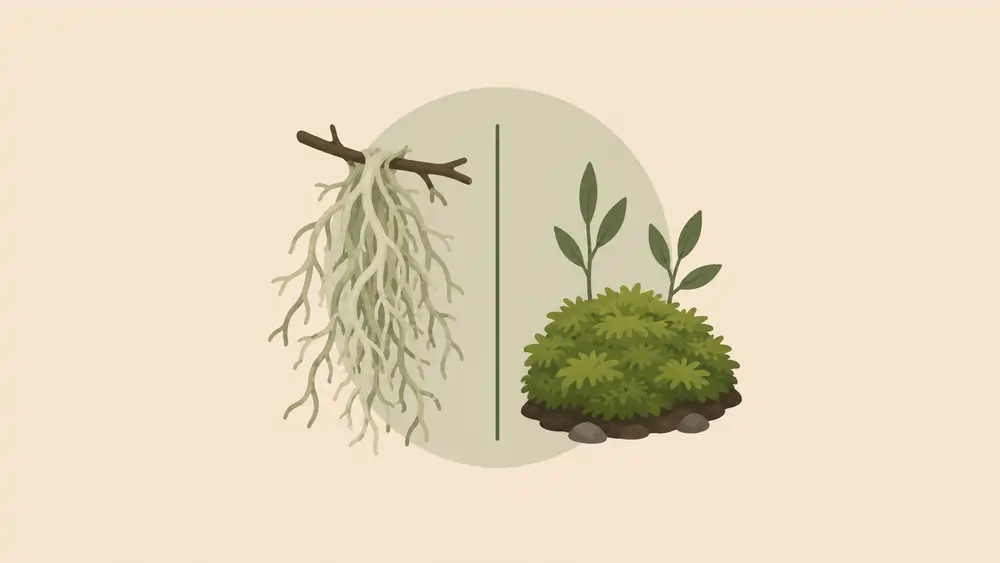
No. Usnea is not moss. Usnea is a lichen.
A lichen is a partnership involving a fungus and a photosynthetic partner, such as an alga or cyanobacterium. Moss is a small non-flowering plant. These are different biological groups, even if they can both grow on trees, rocks, bark, or damp surfaces.
The confusion usually comes from appearance and common names. Usnea may look stringy, fuzzy, or beard-like, but that does not make it moss.
Quick Answer: Usnea vs Moss
| Feature | Usnea | True Moss |
|---|---|---|
| Biological group | Lichen | Plant |
| Structure | Fungal body with photosynthetic partner | Small leafy non-flowering plant |
| Common look | Hairy, stringy, beard-like, branching | Soft mats, cushions, carpets, tufts |
| Where it grows | Often on tree bark and branches | Often on soil, rocks, logs, bark, shaded surfaces |
| Common-name confusion | Old man’s beard, beard lichen, beard moss | Moss, sheet moss, cushion moss, tree moss |
What Is Usnea?
Usnea is a genus of lichens. Many Usnea species have a hanging, branching, hair-like form. This is why people often call them old man’s beard.
Usnea often appears pale green, gray-green, or yellow-green. It may grow on tree branches, bark, shrubs, and sometimes other surfaces. It can look like a tiny tangled beard or loose branching threads.
Because there are many Usnea species, common-name identification is not enough for serious comparison, product sourcing, or foraging decisions.
What Is Moss?
Moss is a small non-flowering plant. Mosses are bryophytes, which means they do not have seeds or flowers like many familiar garden plants.
Most moss grows in mats, cushions, carpets, or tufts. Moss may look soft, green, velvety, dense, and low-growing. It often grows on shaded soil, rocks, logs, roofs, walls, tree bases, or damp surfaces.
Moss is not a lichen. It has a different structure, life cycle, and biological identity.
Why Do People Call Usnea “Old Man’s Beard”?
People call Usnea old man’s beard because of its shape. It hangs or branches like a small beard from trees and branches.
Common names are usually based on appearance, not precise biology. That is why “old man’s beard” can be helpful visually but weak scientifically.
The same nickname can also be used for other plants in different regions, which makes the confusion worse.
Why “Beard Moss” Is a Confusing Name
“Beard moss” sounds like moss, but it may refer to lichen-like material or hanging tree growth rather than true moss. Common names often compress appearance into a simple phrase.
If something is called beard moss, tree moss, old man’s beard, or hanging moss, do not assume the name gives the biological group.
Use botanical identification, structure, and reliable references instead of the common name alone.
What About Spanish Moss?
Spanish moss is another major source of confusion. Despite its name, Spanish moss is not true moss. It is a flowering plant in the bromeliad family.
Spanish moss often hangs from trees in long, gray-green strands, especially in warm and humid regions. It can look superficially similar to hanging lichens from a distance, but it is a different organism.
This is a perfect example of why common names can mislead. “Moss” in a name does not guarantee true moss.
Usnea vs Spanish Moss vs True Moss
| Name | What It Actually Is | Common Appearance | Main Confusion |
|---|---|---|---|
| Usnea | Lichen | Branching, beard-like, pale green strands | Often mistaken for moss |
| Spanish moss | Flowering plant, bromeliad | Long gray-green hanging strands | Has “moss” in the name but is not moss |
| True moss | Bryophyte plant | Low mats, cushions, carpets, or tufts | Often used as a catch-all word for green growth |
| Tree moss | Ambiguous common name | Depends on local usage | May refer to moss, lichen, or other growth |
How Can You Tell Usnea From Moss?
Usnea usually looks stringy, branching, and beard-like. True moss usually forms low mats, carpets, cushions, or soft tufts.
Usnea often hangs from branches or grows in small shrubby clusters on bark. Moss usually looks more like a green surface layer or cushion.
Texture can help, but it is not enough. Lighting, moisture, age, and environment can change appearance.
The Inner Cord Clue in Usnea
Many Usnea lichens have an elastic central cord inside the outer layer. When gently pulled apart, a pale inner strand may be visible.
This feature is often mentioned in basic Usnea identification discussions. However, beginners should not rely on one feature alone. Other lichens can look similar, and not every field situation is clear.
Use multiple identification clues and expert references, especially before any harvesting or product-related decision.
Why Common Names Are Not Enough
Common names are flexible. They vary by region, culture, trade, and appearance. One common name may refer to different organisms. One organism may have several common names.
Old man’s beard can refer to Usnea in many contexts, but it may also refer to unrelated plants in other regions. Beard moss and tree moss are even less precise.
For product labels, botanical names and plant group identity are more reliable than common names alone.
Why Botanical Identity Matters on Labels
If you buy dried Usnea, a tincture, or any botanical product, the label should clarify what the ingredient is. A stronger label may include the genus Usnea, sometimes species information, plant or lichen part, extract type, alcohol or glycerin base for tinctures, serving directions, and warnings.
A vague label that only says “old man’s beard” or “tree moss” can create confusion.
Secrets Of The Tribe takes a cautious editorial stance here: common names can help people recognize a category, but botanical identity helps them compare products responsibly.
Why Foraging Usnea Is Not the Same as Buying It
Wild-harvested material can carry identification, contamination, legality, sustainability, and quality concerns. Lichens grow slowly in many environments and may be sensitive to air quality and habitat conditions.
Roadside, industrial, urban, sprayed, or polluted areas are not good sources for any wild-collected botanical or lichen material.
Buying from a transparent supplier is different from collecting random hanging growth from a tree.
Why Usnea Sustainability Matters
Many lichens grow slowly compared with common garden herbs. Overharvesting can be a concern when demand increases or when people collect irresponsibly.
Responsible sourcing should consider habitat, regrowth, local rules, and whether material is gathered from fallen branches rather than stripped from living trees.
A product page or supplier should not treat slow-growing lichens like unlimited raw material.
Why “Moss” in Marketing Can Mislead Buyers
Some labels and product descriptions use moss-like language because it sounds familiar. But familiar wording can blur important differences between lichens, mosses, bromeliads, and other tree-hanging organisms.
If a product says beard moss, old man’s beard, tree moss, or forest moss, check what it actually contains.
For serious comparison, the label should not leave the organism’s identity vague.
What to Look for Before Buying Usnea
Look for a clear ingredient identity. The word Usnea should appear if the product is supposed to be Usnea. A botanical or lichen-specific name is better than only a common name.
Check whether the product is dried whole lichen, cut material, powder, tincture, glycerite, capsule, or extract. Each format creates a different buyer experience.
Also check sourcing language, harvest method, country or region when available, testing information, serving directions, and warnings.
How Beginners Should Approach Field Identification
Beginners should use more than one clue. Look at growth form, color, branching pattern, attachment point, habitat, texture, and whether the material has a central cord.
Compare with multiple reliable field guides or local experts. Do not rely on a single social media photo or a common-name guess.
Do not harvest, consume, prepare, or sell wild material based only on the idea that it looks like old man’s beard.
Usnea vs Moss Identification Checklist
Use this checklist when you see a pale, green, gray, or stringy growth on a tree and wonder whether it is Usnea, moss, Spanish moss, or something else. The goal is not instant certainty; the goal is to avoid common-name mistakes.
Check the Growth Form
Usnea often looks branching and beard-like. True moss usually forms mats, cushions, carpets, or tufts.
Check the Biological Category
Usnea is a lichen. True moss is a bryophyte plant. Spanish moss is a flowering plant, not moss.
Look Beyond the Common Name
Old man’s beard, beard moss, tree moss, and Spanish moss can all mislead beginners.
Observe the Attachment
Usnea may attach to bark or branches in small branching clusters. Moss often spreads across surfaces in a lower, denser layer.
Consider the Inner Cord Clue
Many Usnea species have a central cord, but this should not be the only identification feature.
Compare With Local References
Use regional field guides or qualified local experts because common names and look-alikes vary by area.
Avoid Roadside Collection
Do not collect material from polluted, sprayed, industrial, or high-traffic areas.
Check Sustainability
Lichens can grow slowly. Avoid stripping living trees or collecting heavily from one location.
Do Not Use Uncertain Material
If identification is uncertain, do not use it for tea, tincture, product making, or any herbal purpose.
Common Mistakes to Avoid
Assuming Anything Hanging From a Tree Is Moss
Tree-hanging growth can be lichen, moss, bromeliad, algae, vine, or another organism.
Trusting “Old Man’s Beard” as a Precise Name
Old man’s beard is descriptive, but not always enough for precise identification.
Confusing Spanish Moss With Usnea
Spanish moss is a flowering plant in the bromeliad family. Usnea is a lichen.
Using One Visual Clue
Color or fuzziness alone is not enough. Use multiple identification features.
Foraging Without Local Knowledge
Local laws, habitat concerns, pollution, and look-alikes all matter.
FAQ on Usnea vs Moss
Is Usnea a moss?
No. Usnea is a lichen, not true moss.
Why is Usnea called old man’s beard?
It is called old man’s beard because many Usnea species grow in hanging, branching, beard-like strands.
Is old man’s beard always Usnea?
No. Common names vary by region and may refer to different organisms.
Is Spanish moss the same as Usnea?
No. Spanish moss is a flowering plant in the bromeliad family, while Usnea is a lichen.
Is Spanish moss true moss?
No. Despite its name, Spanish moss is not true moss.
How can I tell Usnea from moss?
Usnea is usually branching and beard-like, while true moss usually forms low mats, cushions, or carpets.
What is the inner cord in Usnea?
Many Usnea lichens have a pale, elastic central cord inside the outer layer, but this should not be used alone for identification.
Can I collect Usnea from trees?
Do not collect unless identification is certain, local rules allow it, the area is clean, and sustainability is considered.
What should I check on a Usnea product label?
Check for the name Usnea, species information when available, form, sourcing, serving directions, warnings, and testing information.
Glossary
Usnea
A genus of lichens often called old man’s beard because of its branching, hair-like appearance.
Lichen
A partnership involving a fungus and a photosynthetic partner such as an alga or cyanobacterium.
Moss
A small non-flowering plant that often grows in mats, cushions, carpets, or tufts.
Bryophyte
A group of small non-flowering plants that includes mosses.
Old Man’s Beard
A common name often used for beard-like Usnea lichens, but also used for other organisms in some regions.
Spanish Moss
A flowering plant in the bromeliad family that hangs from trees and is not true moss.
Common Name
A non-scientific name that may vary by region and may refer to more than one organism.
Botanical Identity
The more precise naming and classification of a plant or organism.
Central Cord
A pale inner strand found in many Usnea lichens and often used as one identification clue.
Sustainable Harvesting
Collecting in a way that considers regrowth, habitat, local rules, and long-term availability.
Conclusion
Usnea vs Moss comes down to biological identity: Usnea is a lichen, true moss is a bryophyte plant, and Spanish moss is a flowering plant. Common names can help describe appearance, but they are not enough for accurate identification or responsible buying.
Sources
Usnea overview and lichen identification context, Encyclopedia of Life — eol.org/pages/19688
Lichen biology and fungus-photosynthetic partner explanation, U.S. Forest Service — fs.usda.gov/wildflowers/beauty/lichens
Moss and bryophyte overview, Encyclopaedia Britannica — britannica.com/plant/moss-plant
Spanish moss classification and bromeliad identity, Encyclopaedia Britannica — britannica.com/plant/Spanish-moss
Spanish moss plant profile and clarification that it is not a moss, University of Florida IFAS Extension — gardeningsolutions.ifas.ufl.edu/plants/ornamentals/spanish-moss
Usnea identification discussion including old man’s beard common-name context, Oregon State University Extension — extension.oregonstate.edu
Lichen conservation and slow-growth context, British Lichen Society — britishlichensociety.org.uk
Dietary supplement consumer guidance and label-reading basics, U.S. Food and Drug Administration — fda.gov/food/information-consumers-using-dietary-supplements/questions-and-answers-dietary-supplements