In healthcare, delays don’t always come from treatment. Sometimes, they come from paperwork.
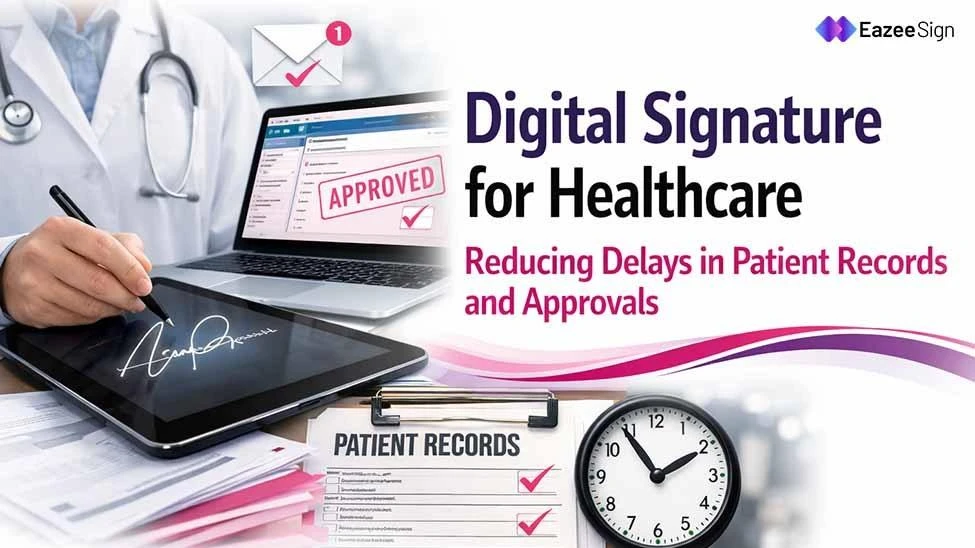
A consent form waiting for approval, a report that needs signing, or an insurance document stuck between departments — All these things look small, but they affect timelines more than expected,and there is a situation when multiple people are involved and everything depends on the next step getting completed on time.
This is where digital signature for healthcare starts making a difference. Because,
Instead of depending on physical movement, it allows hospitals and clinics to shift into electronic signature systems that allow documents to be signed and shared instantly, without slowing down the process.
Why Document Handling is Critical in Healthcare
Healthcare documents are not just records. They carry responsibility.
Every form, report, or agreement often involves sensitive patient data, and even a small mistake or delay can create complications. At the same time, these documents usually pass through multiple hands, doctors, administrators, insurance teams, sometimes even external partners.
That’s where things get tricky. One missing signature can delay a process that should have been completed earlier.
Manual handling makes it harder to track. You don’t always know where the document is, or who still needs to sign it.
What is Digital Signature for Healthcare?
At a basic level, it’s a way to sign medical documents digitally. That’s it.
But in practice, it does more than just replace a signature. A digital signature for healthcare ensures that the identity of the signer is verified and the document remains unchanged after signing, which becomes important when records need to be accurate and traceable.
You might also hear the term electronic signature. It’s commonly used in healthcare for everyday documentation where quick approvals are needed without adding complexity.
For most use cases, this approach works well without making the process complicated.
How Digital Signature Works in Healthcare Systems
The process is simple. It doesn’t require much effort to understand.
A document is uploaded into the system first. Then it is assigned to the required person, it could be a doctor, a patient, or an admin depending on the situation. Once they receive it, they can review and sign it directly.
After signing, the document moves to the next step. No need to print, scan, or send files manually.
Everything happens in one place. And you can track what’s completed and what’s still pending without guessing.
Key Benefits of Digital Signature for Healthcare
The benefits become clear once you start using a digital signature for healthcare.
First, speed. Documents that used to take hours or even days can be completed much faster, which matters in healthcare where time is often critical.
Then comes accuracy. Since everything is recorded, it reduces chances of missing information or incomplete approvals.
Security is another important factor. Patient data is sensitive, and digital systems help protect it with controlled access and tracking.
It also improves coordination. Different departments can work on the same document without delays or confusion.
And in urgent situations, this becomes even more useful. You don’t wait for documents to move physically. You act on them.
Common Use Cases in Healthcare
It fits into daily workflows quite easily.
Patient consent forms are one of the most common examples. Instead of handling them manually, they can be signed and stored digitally.
Insurance documents are another. These often require multiple approvals, and digital signing helps speed things up.
Then there are internal processes. Staff onboarding, agreements, compliance documents, all of these involve signatures at different stages.
Even prescriptions or medical approvals can be managed more efficiently when the process is digital.
Security and Compliance in Healthcare Digital Signatures
Security matters here. It’s not optional.
Digital signature systems use encryption and access control to make sure only authorized people can view or sign documents. This helps protect sensitive patient information.
There is also an audit trail. Every action is recorded, who signed, when it happened, and what changes were made.
This level of tracking helps during verification and ensures accountability across the system.
Why Healthcare Providers Choose EazeeSign
Not every tool fits healthcare workflows. Some feel too complex.
EazeeSign works as a cloud-based solution that keeps things simple. You can upload documents, assign signers, and track progress without dealing with unnecessary steps.
It supports multiple signers, which is important in healthcare where approvals often happen in sequence.
Since it works online, there’s no need for installation. Teams across departments can access it easily.
For providers looking for a practical electronic signature solution, this kind of setup helps maintain both speed and control without adding complexity.
Challenges Without Digital Signature in Healthcare
Without digital systems, things slow down.
Documents get delayed, approvals take longer, and tracking becomes difficult. Sometimes, files get misplaced or require repeated follow-ups.
Manual processes also increase the chances of errors. And in healthcare, even small mistakes can create bigger issues later.
That’s why many providers are moving away from traditional methods.
Conclusion
Healthcare is already complex. Document handling shouldn’t add to it.
With digital signature for healthcare, processes become faster, more structured, and easier to manage. You don’t remove the importance of documentation, you just remove the friction around it.
And once that shift happens, the difference is noticeable.